
#population and sample variance/std deviation
Variance measures how far each data point in the set is from the mean and
thus from every other point in the set. It is the average of the squared differences from the mean.
Population variance is calculated when you have data for the entire population.
It gives a measure of the dispersion of all data points in the population.
Sample variance is calculated when youre working with a sample taken from a larger population.
It estimates the variance of the entire population based on this sample
Use Population Variance When:
You have data for every individual in the population (e.g., census data).
You’re analyzing a small, finite, and complete dataset where all members are included.
Use Sample Variance When:
Suppose a teacher records the test scores of all 30 students in a class.
The teacher calculates the variance using the population formula because the data
represents the entire population of interest.
You have data from only a part of the population (a sample).
You’re making inferences about a population based on the data from a sample.
The population is too large or difficult to completely sample, so you rely on a smaller subset.
Suppose a researcher wants to estimate the average height of adult men in a country.
The researcher measures the heights of 100 randomly selected men
Standard Deviation (SD) is simply the square root of the variance.
It provides a measure of the dispersion of data points in the same unit as the data itself,
making it more interpretable
					import numpy as np
import statistics as stats
					# Creating a dataset
data = [2, 4, 4, 4, 5, 5, 7, 9]
#Example 1 Population Variance and STD Manual
					# Calculate the mean
mean = sum(data) / len(data)
mean

squared_diffs = [(x - mean) ** 2 for x in data]
					# Calculate population variance
pop_variance_manual = sum(squared_diffs) / len(data)
print(pop_variance_manual)

pop_std_dev_manual = pop_variance_manual ** 0.5
print(pop_std_dev_manual)

#Example 2 Sample Variance and STD Manual
sample_variance_manual = sum(squared_diffs) / (len(data) - 1)
print(sample_variance_manual)

sample_std_dev_manual = sample_variance_manual ** 0.5
print(sample_std_dev_manual)
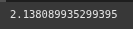
#Example 3: numpy population variance and std
pop_variance = np.var(data)
print("Population Variance:", pop_variance)

					# Population standard deviation
pop_std_dev = np.std(data)
print("Population Standard Deviation:", pop_std_dev)

#Example 4: numpy sample variance and std
sample_variance = np.var(data, ddof=1) # ddof=1 means delta degrees of freedom = 1
print("Sample Variance:", sample_variance)

					# Sample standard deviation
sample_std_dev = np.std(data, ddof=1)
print("Sample Standard Deviation:", sample_std_dev)

#Example 5: statistics sample variance
					# Population variance (not directly available in statistics library)
# Using N-1 correction factor for sample variance
sample_variance = stats.variance(data)
print("Sample Variance (using statistics):", sample_variance)

					# Sample standard deviation
sample_std_dev = stats.stdev(data)
print("Sample Standard Deviation (using statistics):", sample_std_dev)

