







Table of Contents

#LASSO stands for Least Absolute Shrinkage and Selection Operator
#L1 regularization

#address overfitting – A model that is too complex may fit the training data very well
#but perform poorly on new, unseen data

#will get rid ofe useless features (make coefficients independent var next to 0)
#- automatic feature selection

# lead to a simpler model that is less prone to overfitting
https://www.youtube.com/watch?v=VqKq78PVO9g&ab_channel=codebasics 1:24
				
					from sklearn.datasets import fetch_california_housing
				
			
#https://inria.github.io/scikit-learn-mooc/python_scripts/datasets_california_housing.html
				
					ca_housing = fetch_california_housing()


					X = ca_housing.data


					y = ca_housing.target


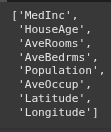
					ca_housing.feature_names


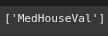
					ca_housing.target_names


					from sklearn.model_selection import train_test_split


					X_train, X_test, y_train, y_test = train_test_split(X, y, test_size=0.2, random_state=19)
				
			
#Lasso regularization is sensitive to the scale of the features,
#so it’s a good practice to standardize the data to have zero mean and unit variance.
				
					from sklearn.preprocessing import StandardScaler


					scaler = StandardScaler()


					X_train = scaler.fit_transform(X_train)


					X_test = scaler.transform(X_test)


					from sklearn.linear_model import Lasso


					lasso = Lasso()


					lasso.fit(X_train, y_train)


					from sklearn.metrics import mean_absolute_error, mean_squared_error, r2_score


					y_pred = lasso.predict(X_test)


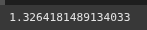
					mean_absolute_error(y_test, y_pred)


					mean_squared_error(y_test, y_pred)


					r2_score(y_test, y_pred)
				
			
#apply a param grid

#Alpha controls the strength of the regularization penalty

#You can fine-tune the alpha parameter to control the strength of the regularization penalty.
#Smaller values of alpha will result in less regularization,
#while larger values will increase the regularization effect and drive more coefficients to zero.
				
					param_grid = {
    'alpha' : [0.001, 0.01, 0.1, 1.0, 10.0, 100.0]
}


					from sklearn.model_selection import GridSearchCV


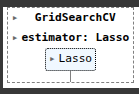
					lasso_cv = GridSearchCV(lasso, param_grid, cv=3, n_jobs=-1)


					lasso_cv.fit(X_train, y_train)


					y_pred = lasso_cv.predict(X_test)


					mean_absolute_error(y_test, y_pred)


					mean_squared_error(y_test, y_pred)


					r2_score(y_test, y_pred)


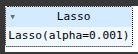
					lasso_cv.best_estimator_


					lasso3.intercept_


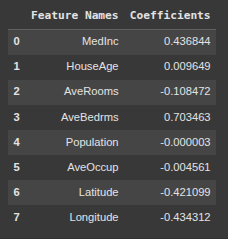
					lasso3.coef_
				
			
#if a coefficient was zero, then the lasso model would disregard it
				
					import pandas as pd


					feature_names = ['MedInc', 'HouseAge', 'AveRooms', 'AveBedrms', 'Population', 'AveOccup', 'Latitude', 'Longitude']


					df = pd.DataFrame({'Feature Names': feature_names, 'Coefficients': lasso3.coef_})


					df


Free Community

Join 1,000+ AI Automation Builders

Weekly tutorials, live calls & direct access to Ryan & Matt.

Join Free →

Keep Learning

Kaggle House price prediction Regression Analysis

train_df = train_df.drop(columns=['PoolQC', 'MiscFeature', 'Alley', 'Fence', 'GarageYrBlt', 'GarageCond', 'BsmtFinType2']) test_df = test_df.drop(columns=['PoolQC', 'MiscFeature', 'Alley', 'Fence', 'GarageYrBlt', 'GarageCond', 'BsmtFinType2']) #drop GarageArea or GarageCars...

kaggle titanic tutorial

https://www.kaggle.com/code/ryannolan1/titanic-voting-classifier-0-78947?scriptVersionId=149342442&cellId=2https://www.kaggle.com/code/ryannolan1/titanic-voting-classifier-0-78947?scriptVersionId=149342442&cellId=2 #military - Capt, Col, Major #noble - Jonkheer, the Countess, Don, Lady, Sir #unmaried Female - Mlle, Ms, Mme #NEW Drop...

hyperparameter tuning with scikit learn

We would be looking at tuning hyperparameters with Scikit-Learn. Scikit-Learn is a powerful machine learning library for Python. It provides simple ,...

principal component analysis scikit learn

PCA (Principal Component Analysis) in Python using Scikit-learn is a technique used to reduce the number of features in a dataset while...